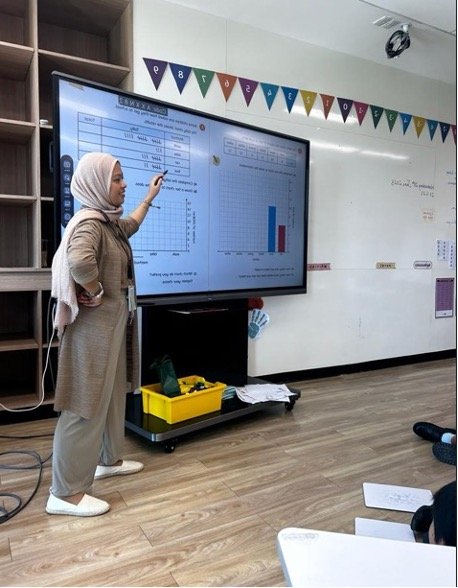
What began as a dream of studying abroad became a career in a Thai classroom, where this SDIS and SMPIS alumna discovered that teaching is about more than language—it is also about understanding people.
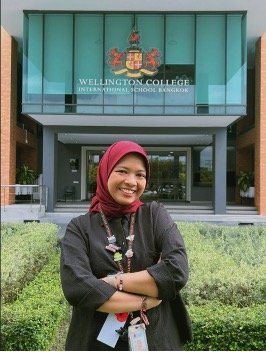
MALANG — Not every dream unfolds as planned. Audria Granada Pridapradana, S.Pd., once hoped to pursue her studies overseas. However, the scholarship she received led her to continue her education in Indonesia. Her desire to experience life abroad never faded. Several years later, she found her way overseas—not as a student, but as a teacher in Bangkok, Thailand.
Audria is an alumna of SD Islam Sabilillah Malang 1 and SMP Islam Sabilillah Malang, both from the fifth graduating cohorts. For her, the years she spent at Sabilillah were about more than academic lessons. The school’s disciplined yet supportive environment, together with the values practised in everyday life, helped shape her understanding of responsibility, compassion, and leadership.
One message from a teacher has stayed with her over the years: character is revealed by what a person does when no one is watching. In her reflection, Audria recalls that this lesson left a deeper impression on her than many things she learned from textbooks.
Her school memories are also closely tied to experiences beyond the classroom. During elementary school, a trip to Yogyakarta introduced her to the history of Borobudur, the lively atmosphere of Malioboro, and even the art of bargaining with local vendors. In junior high school, trips to Jakarta and Bandung, along with visits to several Wali Songo sites, broadened her horizons. A pilgrimage to Sunan Ampel in Surabaya before final examinations also became a lasting memory—including an encounter with a dishonest vendor that she now looks back on as a lesson in being more cautious.
Audria’s desire to live and study abroad grew stronger during university, when she joined a one-month international internship programme in Hat Yai, southern Thailand. Although the experience was brief, it left a lasting impression. She knew she wanted to return to Thailand, even though she had no idea how that opportunity would eventually come about.
Shortly before graduating, a Filipino friend working in Bangkok contacted her with news that a school urgently needed an English teacher. After exchanging emails with the head of the English department, Audria was offered the position. That opportunity marked the beginning of her teaching career in Thailand. According to her account, she has now spent around seven years teaching in Bangkok and is currently working at her second school.
What she had once imagined as a journey abroad to pursue further studies had taken an unexpected turn. Instead of becoming an international student, she had found her path as an international educator.
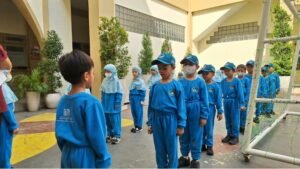
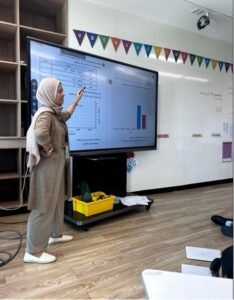
Teaching children whose first language is Thai presented a unique set of challenges. Even simple instructions could be difficult to communicate, while cultural differences influenced how students interacted and learned. Audria had to adapt her teaching methods by incorporating pictures and gestures, giving clear and concise instructions, establishing consistent classroom routines, and celebrating each child’s small achievements.
The challenges extended beyond language. Homesickness, cultural misunderstandings, and the expectations associated with being a foreign teacher became part of her adjustment. Over time, she worked to build trust with her students, learn basic Thai expressions, and embrace local customs, including the traditional wai greeting and school ceremonies.
Through these experiences, Audria came to understand that adapting to a new environment does not mean losing one’s identity. Rather, it means expanding one’s ability to understand and connect with others. In the classroom, she learned that teaching requires more than delivering lessons. It also means listening carefully, reading body language, and recognising what students may struggle to express in words.
These experiences have also shaped her philosophy of teaching. For Audria, being a good teacher does not mean being perfect. It means being present, remaining willing to adapt, and leading by example. She believes that children may remember how a teacher made them feel long after they have forgotten the lessons taught in class.
For Audria, the education she received at Sabilillah has provided a foundation that extends far beyond academic achievement. The Islamic values instilled during her school years continue to guide her through life. She also expresses deep gratitude to her mother, who insisted on enrolling her at Sekolah Sabilillah—a decision she believes helped shape the course of her life.
Audria’s journey illustrates that education does not always lead to the future we initially envision. Plans may change, opportunities may arise through unexpected connections, and some of life’s most meaningful lessons only become clear through experience. From the classrooms of Malang to those of Bangkok, the character values she encountered during her school years continue to find expression in her everyday work.
Her message to the next generation of students is simple: never underestimate the value of small lessons and everyday experiences. Their true significance may only become apparent when you begin to navigate a much wider world.